





Record July heat in California and fires (2018)
California had its hottest month to date. Death Valley, the hottest location in the nation, also notched its hottest July for a second straight year.
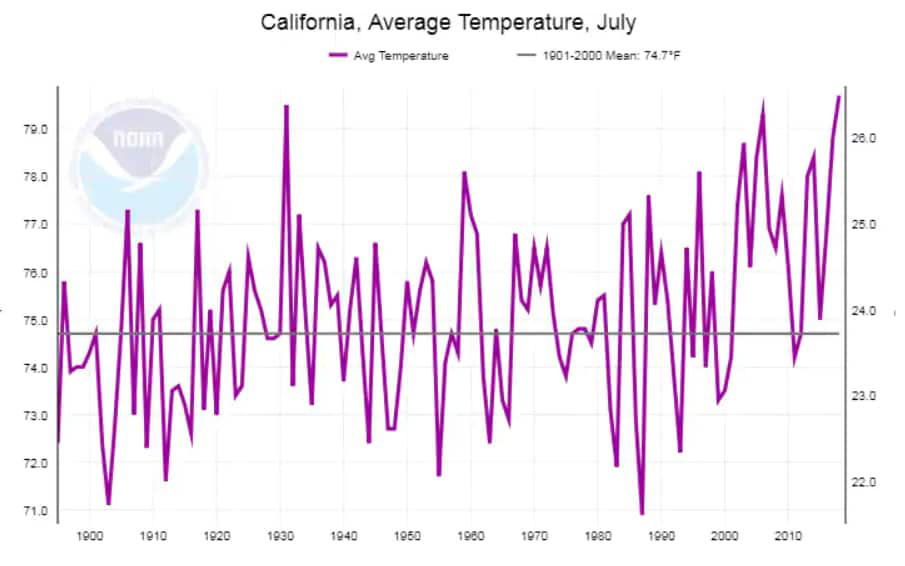
2018 was the hottest year on record in California. (NOAA)
California had its hottest month to date. Death Valley, the hottest location in the nation, also notched its hottest July for a second straight year.
California’s scorching July was headlined by a historic heat wave in Southern California on July 6. Most records for the date were obliterated, and quite a few of the highest temperatures were the highest recorded for July or any other month, known as “all-time” records.
The state averaged a temperature of 79.7 degrees, besting the old record of 79.5 in July 1931. It was a full five degrees above normal for the month.
Several massive fires erupted across California, including the Mendocino Complex, which was the third largest on record in the state. The hot and dry summer lasted deep into fall, with conditions remaining much drier than normal through early November, when the weather-aided Camp Fire erupted, the state’s most damaging and deadliest blaze on record.
According to NOAA National Centers for Environmental Information (NCEI), in 2018, California has experienced its costliest, deadliest and largest wildfires to date, with records back to 1933. The Camp Fire is the costliest and deadliest wildfire - destroying more than 18,500 buildings. California also endured its largest wildfire on record - the Mendocino Complex Fire - burning over 450,000 acres. Additionally, California was impacted by other destructive wildfires: the Carr Fire in Northern California and the Woolsey Fire in Southern California. The total 2018 wildfire costs in California (with minor costs in other Western states) approach 24.0 billion - a new U.S. record. In total, over 8.7 million acres has burned across the U.S. during 2018, which is well above the 10-year average (2009-2018) of 6.8 million acres. The last 2 years of U.S. wildfire damage has been unprecedented in damage, with losses exceeding 40.0 billion.

